F1 Predictions: Race-Week Analysis You Can Actually Check
Every Thursday of a race week, this page publishes our f1 predictions for the coming Grand Prix: five analysed positions with reasoning, prices at the time of writing and a confidence grade for each. No anonymous hunches, no fifty-word guesses, no deleted losers. Every call we have ever made sits in the public record below, settled and dated - because formula 1 predictions are only worth reading when the tipster's season is visible, not just his last winner. Our analysts cover the full calendar for bettors in India and South Asia, with every price referenced from bookmakers we have tested with our own money.
How to use this page: read the five calls, read the reasoning behind them, and then - this is the important part - compare against your own judgement. The best use of anyone's f1 betting predictions is as a disciplined second opinion. When our analysis matches yours, you have confirmation; when it contradicts yours, you have a question worth answering before you stake. Either way, you bet better. Below: this week's card, our methodology, the season record, and the thinking behind every market type we play.

Mexico City Grand Prix
Autódromo Hermanos Rodríguez · Mexico City, Mexico
Race: Mon 2 Nov · 01:30 IST
| Day | Session | Your time | Status |
|---|---|---|---|
| Sat 31 Oct | Practice 1 | 00:00 IST | |
| Sat 31 Oct | Practice 2 | 03:30 IST | |
| Sat 31 Oct | Practice 3 | 23:00 IST | |
| Sun 1 Nov | Qualifying | 02:30 IST | |
| Mon 2 Nov | Race | 01:30 IST |
This Week's Card: The Five Calls
Updated Monday 26 October 2026, after the United States Grand Prix. Next card: Mexico City Grand Prix, Sunday 1 November (14:00 local, 01:30 IST Monday). All prices are indicative estimates sampled across our listed operators at publication; check the live board before betting.
CALL 1 - Race Winner: Kimi Antonelli, 1.62 est. - Confidence: High. Nine wins from eighteen rounds, pole-to-flag untroubled in Austin, and a Mercedes package whose power-unit efficiency and cooling thrive in Mexico City's thin 2,240-metre air. The Hermanos Rodriguez layout rewards exactly what this car does best: traction out of slow stadium-section corners and braking stability. The title-clinch narrative adds focus, not pressure - he needs only ninth. Take the short price without hesitation; anything above 1.55 holds value.
CALL 2 - Podium Finish: Charles Leclerc, 1.75 est. - Confidence: High. Consecutive second places, fastest in Austin until the Mercedes simply drove away, and a Ferrari whose mechanical grip suits Mexico's slow final sector. Leclerc has historically excelled here - the stadium section is his kind of theatre. The risk is Ferrari strategy roulette, but podium markets forgive that. At anything 1.70 or better this is the card's banker alongside Call 1.
CALL 3 - Pole Position: Max Verstappen, 3.40 est. - Confidence: Medium. The four-time Mexico winner remains the circuit's qualifying king, and thin air compresses drag differences - neutralising Mercedes' straight-line edge for one lap. Austin pole went to Antonelli, but Verstappen's Saturday pace was closer than Sunday suggested. At 3.40 the price overpays a genuine two-horse qualifying duel. Half-unit confidence given Antonelli's current pole conversion rate.
CALL 4 - Head-to-Head: Lando Norris beats Oscar Piastri, 1.70 est. - Confidence: Medium-High. The 2025 Mexico winner against a teammate 63 points behind and fading since summer. Norris's late-braking style suits the long Turn 1 approach, and McLaren's high-altitude cooling package held up in Austin. Piastri's qualifying slump is the tiebreaker. This is the card's value play: driver form says 1.50, the board says 1.70.
CALL 5 - Safety Car: Yes, 1.72 est. - Confidence: Medium. The 800-metre charge into Turn 1 with reduced downforce levels produces the calendar's most reliable first-lap chaos, and the stadium section's unforgiving walls punish mid-race errors. Historical intervention rates here rank with the street circuits. Red-flag territory this is not - but one safety car across 71 laps is closer to even money than the price implies. Full reasoning on the Mexico City race page, updated after qualifying.
The format never changes, and that is deliberate. Five calls per weekend - never more, because discipline beats volume; never fewer, because a single tip is a lottery ticket dressed as analysis. Each card names the market, the selection, the price available at publication time and where we found it. Our f1 predictions today always carry a timestamp, so you can judge whether the number is still there when you come to bet. Grand prix predictions go stale fast - a Thursday price on a practice-linked market may not survive Friday - so we note which calls are time-sensitive and which will hold until lights-out. When you read f1 race predictions anywhere, that timestamp is the first thing to check, ours included.
How We Make Our F1 Predictions
The methodology is boring, and that is a compliment. Every call starts from the circuit, not the driver: venue type, safety-car history, tyre stress and weather exposure set the weekend's shape before any name enters the discussion. Then comes form - not headlines, but the underlying numbers: long-run pace from practice, qualifying delta against teammates, and how each car's characteristics map to the specific layout. Only then do we look at the board, because the whole point of f1 betting analysis is finding where the market's price disagrees with the evidence, not echoing what odds already say.
Two disciplines keep us honest. First, every call must pass the "so what" test: if the reasoning could apply to any race, it applies to none - circuit-specific or it is not published. Second, we grade confidence honestly, and our f1 form analysis says so when a call is a lean rather than a conviction. Anyone wondering how to predict f1 races professionally should steal this structure: venue first, form second, price last, ego nowhere. The predictions record below shows what the method earns across a season - good weeks and bad ones, all on the page.
The Weekend Variables: Weather, Tyres and Track Evolution
Three variables reprice a Grand Prix more than all others combined, and our cards weight them explicitly. Weather first: a forty-percent rain probability is not a footnote but a market event, because wet races multiply variance and reward drivers whose car control exceeds their machinery - history's wet-weather upsets are a pattern, not luck. Tyres second: the compounds a supplier brings to each circuit define strategy windows, and a soft-tyre qualifying edge that fades over a race distance creates predictable divergences between Saturday and Sunday prices. Track evolution third: street circuits rubber in dramatically, meaning early practice times mislead and late runs matter more - a detail that moves driver markets all Friday.
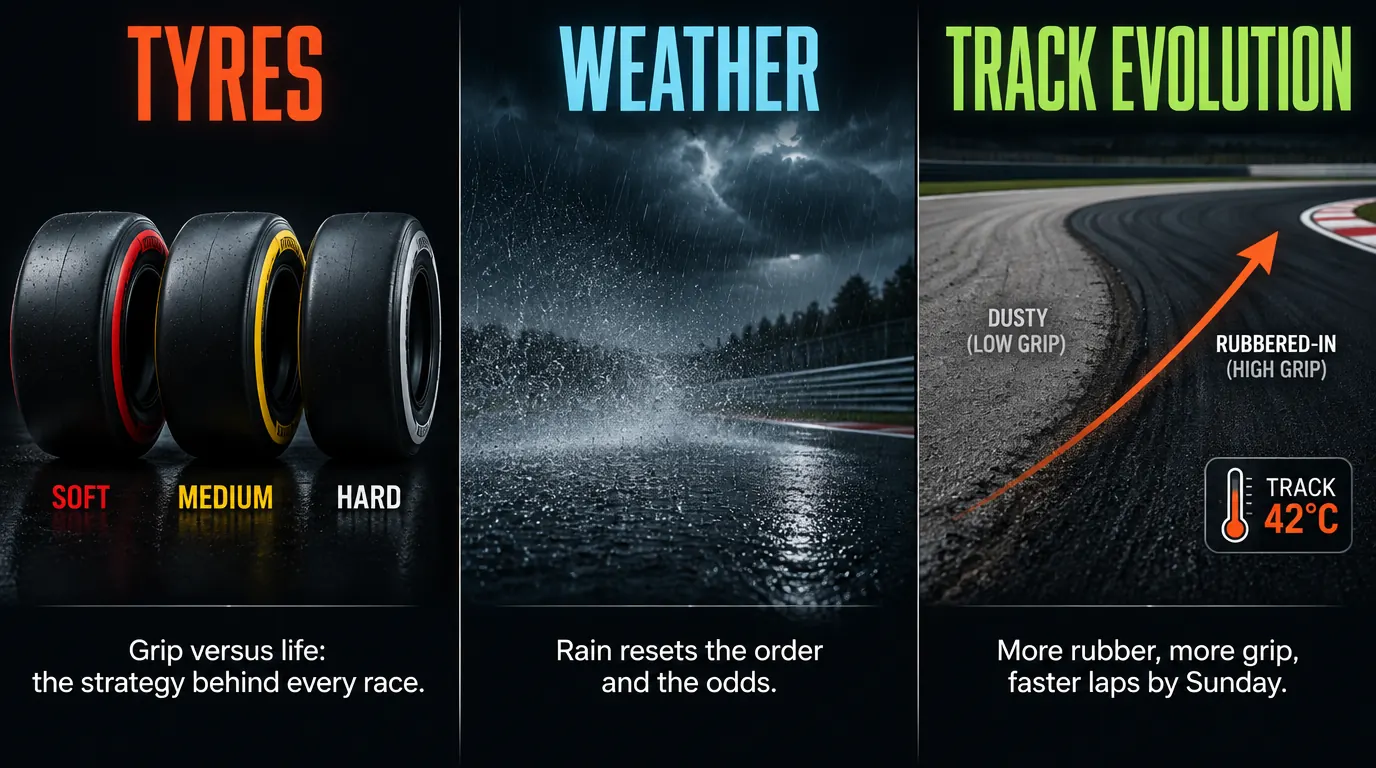
Our reasoning notes reference these variables by name, because transparent logic lets you adjust when conditions change: if Saturday brings a storm Thursday could not see, circuit-fit and form arguments usually strengthen in the wet while raw-pace arguments weaken. Predictions are a starting grid, not a finish line.
Head-to-Heads: The Bettor's Quiet Edge
If we could only play one market type, it would be head-to-head driver duels - the most consistently mispriced product on the board. The reason is structural: casual money bets famous names, while head-to-head prices should reflect machinery, circuit fit and recent form between two specific drivers. A teammate matchup at a venue where one driver has dominated for three straight years, priced near evens because both cars look identical on paper, is the kind of inefficiency our cards hunt weekly. The same logic applies to cross-team duels involving drivers whose reputations lag their current form. Head-to-head betting also removes most race chaos from the equation - you need your man to beat one rival, not nineteen - which is why these markets anchor our confidence-graded calls more often than any other type.

The Season Record, Wins and Losses Included
Settled after the United States Grand Prix, 26 October 2026. The season ledger, all 19 rounds, every card public in the archive:
| Period | Rounds | Calls | Won | Strike Rate | Units Staked | Units Returned | ROI |
|---|---|---|---|---|---|---|---|
| Season 2026 (AUS-USA) | 19 | 95 | 38 | 40.0% | 95.0 | 102.4 | +7.8% |
| Last 5 rounds (ESP-USA) | 5 | 25 | 11 | 44.0% | 25.0 | 28.0 | +12.0% |
| Sprint rounds so far | 5 | 25 | 9 | 36.0% | 25.0 | 23.9 | -4.4% |
The pattern behind the numbers is honest: podium and head-to-head calls carry the profit (31 wins from 70), while pole-position picks (4 from 20) run below expectation - qualifying remains the hardest market on the board. Level-stake followers are ahead. The full archive, every card dated and settled at best available closing price, sits below this table - scroll it before you trust it.
Here is what a real f1 predictions record looks like: some weekends land four calls from five, some land one, and a sprint weekend with a wet Saturday can land none. Across a full season, a disciplined analyst aims to beat the closing price often enough to stay in profit at level stakes - no more, and anyone promising more is selling something. We publish our tipster record settled to the penny: every card, every result, every unit, with running totals after each round. Check it before you follow us. Check it again mid-season. A record you cannot audit is marketing; ours is arithmetic.
Prediction Types: From Race Winners to Props
Our cards draw from the full market menu, and each type has its own logic. The race winner call is the glamour market but rarely the value one - favourites at short prices need a reason to lose, not a reason to win. Podium positions are the workhorse: f1 podium predictions reward drivers whose consistency outruns their headline reputation, and the each-way structure forgives near-misses. Pole position is a one-lap discipline where f1 pole position predictions live and die by circuit type - street qualifying is a different sport from Monza's slipstream lottery. Then come the derivatives our readers underrate: head-to-head driver duels isolate one matchup from the chaos of twenty cars, fastest lap opens up when leaders manage gaps, and safety-car specials pay for knowing a venue's history. A balanced card mixes conviction plays with one or two prices - never five favourites, never five longshots.
Race Pages: Where Grand Prix Detail Lives
One structural rule keeps this site clean: every question has one home. This hub owns the weekly card and the season record; the race page for each Grand Prix owns that weekend's deep preview - circuit statistics, weather outlook, session times in your time zone and a prediction module with race-specific angles like sprint-format adjustments and grid-penalty impacts. If you want the full picture for a specific round, the f1 race previews on our race pages go three times deeper than the hub card can. And if you are searching for tips on a grand prix this weekend, start with the hub card on Thursday, then read the race page on Saturday once qualifying has reshaped the board. The two are built to be read together, forty-eight hours apart.
Sprint Weekends: Different Race, Different Card
Six rounds a season run the sprint format, and our f1 sprint predictions adjust accordingly. Compressed practice - one session before parc ferme locks setups - means less data, softer prices and wider disagreement between our model and the board, which is precisely where value lives. Saturday's sprint is its own betting animal: 100 kilometres, no mandatory stops, aggression levels that Sunday's points-paying distance never sees. Our sprint-weekend cards typically shift weight toward qualifying-based markets and away from strategy-dependent ones, because a locked setup is a known quantity in a way a Sunday strategy never is. The card format stays identical - five calls, reasoning, confidence grades - but the thinking behind sprint weeks is documented in our sprint-format guide for anyone who wants the full picture.
Where to Bet Our Predictions
A prediction is only as good as the price you actually get, which is why every card notes the operator where we found the quoted number. Across the season, that operator is usually Melbet - not by arrangement but by arithmetic. Their board posts early in the week, holds deep liquidity on the derivative markets our cards favour, and in our season sampling offered the best or joint-best price on the majority of positions we published. The mechanics matter too: markets that stay open through safety-car periods, cash-out that functions during live windows, and an app stable enough to act on a Sunday-evening price from a phone on 4G - all verified across a full season of race weekends, not a one-off test.
For readers in India and the wider region, the practical advantages compound: UPI, bKash, JazzCash and eSewa deposits in under a minute, withdrawals inside 24 hours in our tests, and account currencies that never force you through conversion. All five calls each week are priced from licensed, tested operators - if a number on our card has moved by the time you arrive, the odds hub shows you where the value went, and the movers page explains why it left.
Bankroll: The Unsexy Half of Predictions
The best f1 betting strategy ever written fails without staking discipline, so our cards assume a simple framework you should adopt before following anyone's tips. Level stakes are the default: one unit per standard call, half a unit on speculative prices, never more than two on the strongest conviction - and a unit is one to two percent of your total betting budget, not a number that grows when you feel confident. Chasing losses is the bankroll killer that ends more betting careers than bad analysis ever did; the weekend after a losing card is exactly when discipline matters most. Keep a record of your own alongside ours, because bankroll management is personal: your budget, your limits, your call on every stake. Predictions supply the opinion; the money management is entirely yours.
Legal and Responsible
Predictions are analysis and opinion, published for information and entertainment - not financial advice, and never a guarantee. Betting's legal status varies across South Asia, the decision to bet is yours alone, and we insist on one rule regardless of geography: licensed platforms only.
All bookmakers listed on this page hold valid international gambling licences (Curaçao eGaming). If you choose to bet online, do it responsibly and at your own discretion - our advice is simple: always play with licensed platforms and their official apps, so your account, payments and data stay protected.
Set a budget before the weekend, use deposit limits from day one, and treat any losing Sunday as paid entertainment rather than a debt to recover. If betting stops being fun, gamblingtherapy.org offers free, confidential help around the clock. Strictly 18+.
Frequently Asked Questions
When are your F1 predictions published?
Every Thursday of a race week, before the weekend's first session. Each of the five calls carries its price at publication time and a timestamp. Between race weekends, this page previews the next round and links to its detailed race page.
Are your predictions free?
Yes - every call, every week, with the full season record public. The site is funded by affiliate commissions from the bookmakers we test and rank, which is why our rankings follow a published methodology that commissions cannot influence - the full formula is public on our Editorial Policy page. You will never hit a paywall here, and the record page stays free forever.
How accurate are F1 predictions?
Ours are settled publicly after every race, so you never have to take our word for it. Realistic expectations: a disciplined analyst beats the market by single-digit percentages over a season, not by doubling money monthly. Judge us on the record page - wins, losses and running return, all dated.
Which markets do your tips cover?
Race winner, podium, pole position, head-to-head driver duels, fastest lap and safety-car specials - the full board, weighted by where the week's evidence actually sits. A typical card mixes conviction plays at shorter prices with one or two value positions, never five favourites or five longshots.
Where can I bet the predictions?
Every call notes the licensed operator carrying the quoted price - most often Melbet, whose board posted the best or joint-best number on the majority of our published positions this season. If a price has moved since Thursday, our odds hub shows the current market across all listed sites.
Do you change predictions after qualifying?
The Thursday card stands as published - that is what the season record measures. But the race page for each Grand Prix updates its prediction module after qualifying with adjusted angles: grid penalties, weather shifts, the strategic picture. Read the card for the week's thinking, then the race page for the final picture.
Should I bet every call you publish?
No. Five calls is our analysis of where the week's value sits, not an instruction sheet. Bet the calls whose reasoning you independently agree with and never stretch a budget to cover a full card - selective following with level stakes beats blanket following every season.
The Bottom Line
Predictions worth following have three ingredients: a method you can read, a record you can check and a price you can still get. This page is built to supply all three, every race week, all season - through the title fight's finale and into the new regulations beyond it. Read the card on Thursday, read the race page on Saturday, bet your own judgement on Sunday - and keep the stakes boring enough that the worst weekend of the season still feels like entertainment, because the season is long and the bankroll that survives it is the only one that wins it. Lights out is coming; we'll see you on the record page afterwards.
18+ | Betting involves risk. Never bet more than you can afford to lose. This page contains affiliate links. Check the legal status of online betting in your jurisdiction before registering. If gambling stops being fun, visit gamblingtherapy.org.